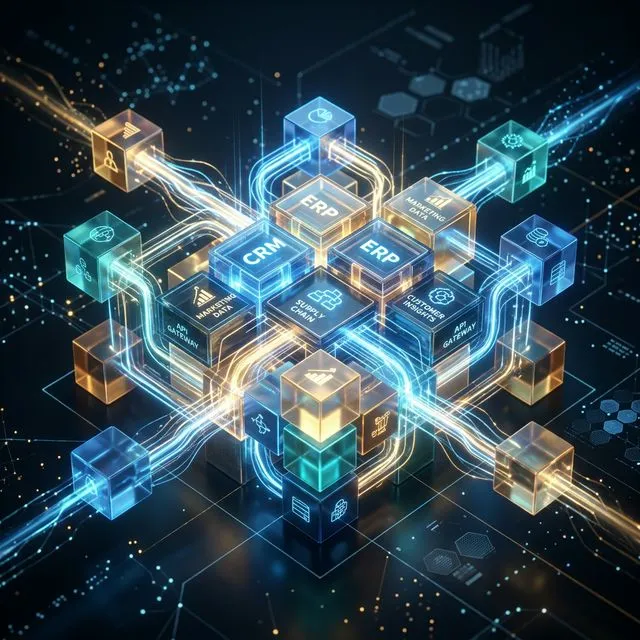
Integrations built for reliability, auditability, and predictable change across your enterprise technology landscape in Singapore.
Challenge
Enterprise integrations often fail due to unclear ownership, inconsistent data contracts, and change without governance. Silent failures accumulate, reconciliations become manual firefighting, and nobody owns the end-to-end flow. Reliable integration needs explicit contracts, monitoring that surfaces drift early, and a disciplined release approach so dependent teams are not surprised. Without that, integrations erode trust in the systems of record.
Outcomes
Practical artefacts that reduce technical uncertainty and support dependable change management in Singapore.
Integration architecture
Structured architectural blueprints with clearly defined system boundaries, data flows, and ownership models for every touchpoint.
API and data contracts
Explicit technical contracts, schema validation, and versioning strategies that prevent breaking changes across your application landscape.
Monitoring and alerts
Granular dashboards for performance, latency, and throughput with automated alerting to detect and resolve integration failures early.
Release discipline
A governed change management process combined with staged rollouts and automated testing that ensures maximum system availability.

From discovery to governable execution with measurable confidence.
Discovery
Thorough mapping of system landscapes, data owners, non-functional requirements, and reconciliation expectations before execution.
Build
Engineering of interfaces with robust error handling, idempotency patterns, and environments that match your corporate governance.
Operate
Active monitoring, alert tuning, and governed configuration changes to ensure integrations remain dependable in production.
Scale
Expanding system intake layers and optimizing responsiveness to support regional expansion and additional operational nodes.
Straight answers on delivery, governance and day-to-day operations.
Can you integrate with legacy systems?
Yes. We design boundaries and contracts that protect delivery while respecting constraints, then introduce controls to reduce risk over time.
How do you handle change control?
We align with your governance requirements and use a repeatable release rhythm with clear decision points and ownership.
Do you support data quality and reconciliation?
We build quality signals and reconciliation patterns so issues are visible early and can be resolved calmly.
How do you avoid duplicate or conflicting records?
We agree keys, merge rules and conflict handling upfront, then validate with realistic data scenarios.
Can you document integrations for audits and handover?
Yes. We produce clear interface catalogues, data flows and operational runbooks suited to your standards.
What happens when an upstream system changes?
Versioning, compatibility windows and regression checks reduce surprise; we coordinate cutovers with owners on both sides.
Do you support event-driven and batch patterns?
Yes. We choose patterns based on latency needs, consistency requirements and operational maturity.
Do you recommend middleware platforms, or work with what we already have?
Both. We assess your existing middleware, identify gaps, and recommend changes only where they materially reduce risk or operational burden.
How do you approach disaster recovery and data consistency across integrated systems?
We design for idempotency and replayability so integrations can recover cleanly. Recovery objectives are agreed during discovery and tested before go-live.
Can you provide staging and test environments that mirror production?
Yes. We align environment strategy to your IT standards and ensure integration tests run against realistic configurations before changes reach production.
Let's discuss how our delivery model can support your specific requirement. We keep communication clean, commercial terms clear, and delivery grounded.